
Inside the Frontline: An Industry Snapshot
Johann Hauswald, PlixAI, CALSAGA Network Partner
The Gap Between Perceived Risk and Operational Reality
Most industry strategies for frontline safety are built on a worst-case foundation: training for rare assaults, staffing for static shifts, and documenting only major incidents. While well?intentioned, this approach leaves organizations prepared for the exception rather than the rule.
An analysis of more than 10,000 incidents across three major U.S. metropolitan areas, captured through AI?powered body?worn cameras, reveals a different operational reality. Risk is not occasional or isolated – it is continuous, routine, and largely invisible to leadership relying on traditional reporting methods.
This snapshot moves beyond anecdote to provide a data?driven view of frontline operations, uncovering a critical visibility gap between what leadership believes is happening and what frontline teams actually experience each day.
Key Findings
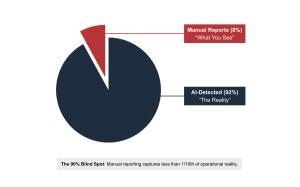
- The 90% Blind Spot: Organizations that rely on manual incident reporting are effectively blind to over 90% of frontline risk signals. While traditional reports capture roughly 8% of activity, automated AI detection shows that operational friction is ongoing, not episodic.
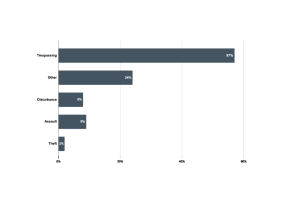
- The 80/20 Workload Reality: Frontline teams are not primarily responding to high?severity crime. 83% of daily activity involves routine compliance issues such as trespassing, access disputes, and refusal to comply, while only 17% of incidents escalate into high?severity events.
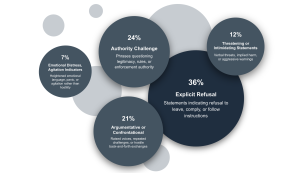
- Escalation is Conversational: Violence is rarely spontaneous. Nearly 70% of escalations begin with verbal resistance or authority challenges, creating a measurable pre?escalation window that often goes unaddressed.
THE VISIBILITY GAP: THE 90% BLIND SPOT
Incident detection follows two primary paths: manual reporting and automated, always?on detection. The data shows that manual reporting captures only a small fraction of real?world interactions.
Key Insight
Organizations relying solely on manual reports operate with a 92% visibility gap. Frontline risk is continuous, but legacy reporting tools capture only isolated moments, leaving leadership unaware of the true volume of operational friction.
Operational Takeaway
You cannot manage risk you do not see. Closing the visibility gap requires moving from after?the?fact reporting to continuous workforce intelligence.
THE 80/20 REALITY: FREQUENCY VS SEVERITY
Incident Breakdown
The data reveals that routine compliance issues such as trespassing, loitering, and access disputes account for the majority of frontline activity, while high?severity incidents remain statistically rare.
Operational Takeaway
Operational efficiency is gained by optimizing for the 80% of interactions that occur daily, not just the extremes. Systems and training must support flexibility, communication, and de?escalation as core competencies.
THE ANATOMY OF ESCALATION: LANGUAGE AS AN EARLY WARNING SYSTEM
Behavioral Triggers Across 10,000 incidents
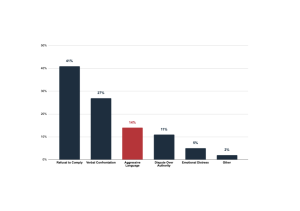
Analysis across thousands of incidents shows that physical aggression is rarely the starting point:
 Linguistic Signals
Instead, non?violent verbal cues – resistance, challenges to authority, and refusal to comply – trigger more than 60% of automated alerts.
Key Insight
Escalation is primarily a conversational breakdown, not a spontaneous physical event. Since nearly 70% of escalations stem from non-compliance and verbal disputes, there is almost always a “pre-escalation window” – a clear period of verbal resistance that occurs well before any physical risk materializes.
Operational Takeaway
Treat language as the earliest indicator of risk. Since verbal resistance reliably precedes physical violence, safety strategies should focus on early intervention. Training staff to recognize and de?escalate specific verbal patterns can prevent many of the incidents that later become severe.
OPTIMIZING COVERAGE: ALLOCATING RESOURCES TO PEAK RISK
Daily & Weekly Patterns
Incident volume does not follow a simple day?versus?night pattern. Instead, activity forms a double?peak curve, clustering around late morning (~11:00 AM) and late evening (~11:00 PM). Volume steadily builds throughout the week, peaking on Fridays, when incidents start earlier and persist later than on other weekdays.
Key Insight
Operational risk aligns with social and business cycles, not just darkness. The late-morning spike suggests friction related to business operations and access, while the Friday surge reflects social movement. Crucially, Friday risk is longer, not just higher meaning standard 8-hour shift blocks often leave the “shoulders” of this high-risk window exposed.
Operational Takeaway
Staff for the curve, not the clock. Static shifts often overserve low?risk early?morning hours while underserving critical peak periods. Effective workforce management requires dynamic scheduling that specifically targets the 11:00 AM / 11:00 PM intensity clusters and extends coverage windows for the weekend ramp-up.
CONCLUSION: FROM ACTIVITY TO INSIGHT
The Reality
A full-distribution view of frontline activity reveals a reality that traditional “top incident” summaries miss. The data proves that risk is continuous, not episodic. Escalation is predictable and conversational, not spontaneous. And crucially, the operational load is driven by volume, not rarity.
The Strategic Shift
Organizations can no longer afford to operate based on the small percentage of incidents that get manually reported. Effective risk management requires visibility across the entire interaction lifecycle – from the first verbal refusal to the final report.
Final Takeaway
Moving from reactive reporting to proactive workforce intelligence enables three immediate advantages:
- Smarter Staffing: Align coverage with real 11:00 AM / 11:00 PM risk curves.
- Effective Training: Focus on the language and behaviors that precede 70% of escalations.
- Defensible ROI: Base staffing, technology, and budget decisions on real operational behavior, not worst-case hypotheticals.
For private security organizations, visibility is no longer a nice to have. It is the foundation of safer teams, stronger operations, and sustainable growth.
 Johann Hauswald is the Founder and CEO of Plix AI, a startup developing AI-enabled body cameras and safety analytics software for private security and field-operations industries. Plix is backed by Sequoia Capital, Andreessen Horowitz (a16z), and the founders of Samsara and Verkada.
Johann earned his Ph.D. in Computer Engineering from the University of Michigan, where he specialized in AI at the edge and computer vision. Before founding Plix, he was a postdoc at Stanford working on large-scale video analytics and edge inference systems and previously co-founded a venture back AI company building conversational AI systems. His work sits at the intersection of AI, safety, and real-time video intelligence, advancing how organizations detect and respond to incidents in the physical world.